
DataGovernance Solution platform
With the unique data governance platform based on an “Information Centric” concept, companies immediately gain transparency, control and a business view of their unstructured data. With the unique data governance platform based on an “Information Centric” concept, companies immediately gain transparency, control and a business view of their unstructured data. Our customers can reduce the effort and costs for data management, implement policies and regulatory requirements quickly and prove that they are compliant at all times
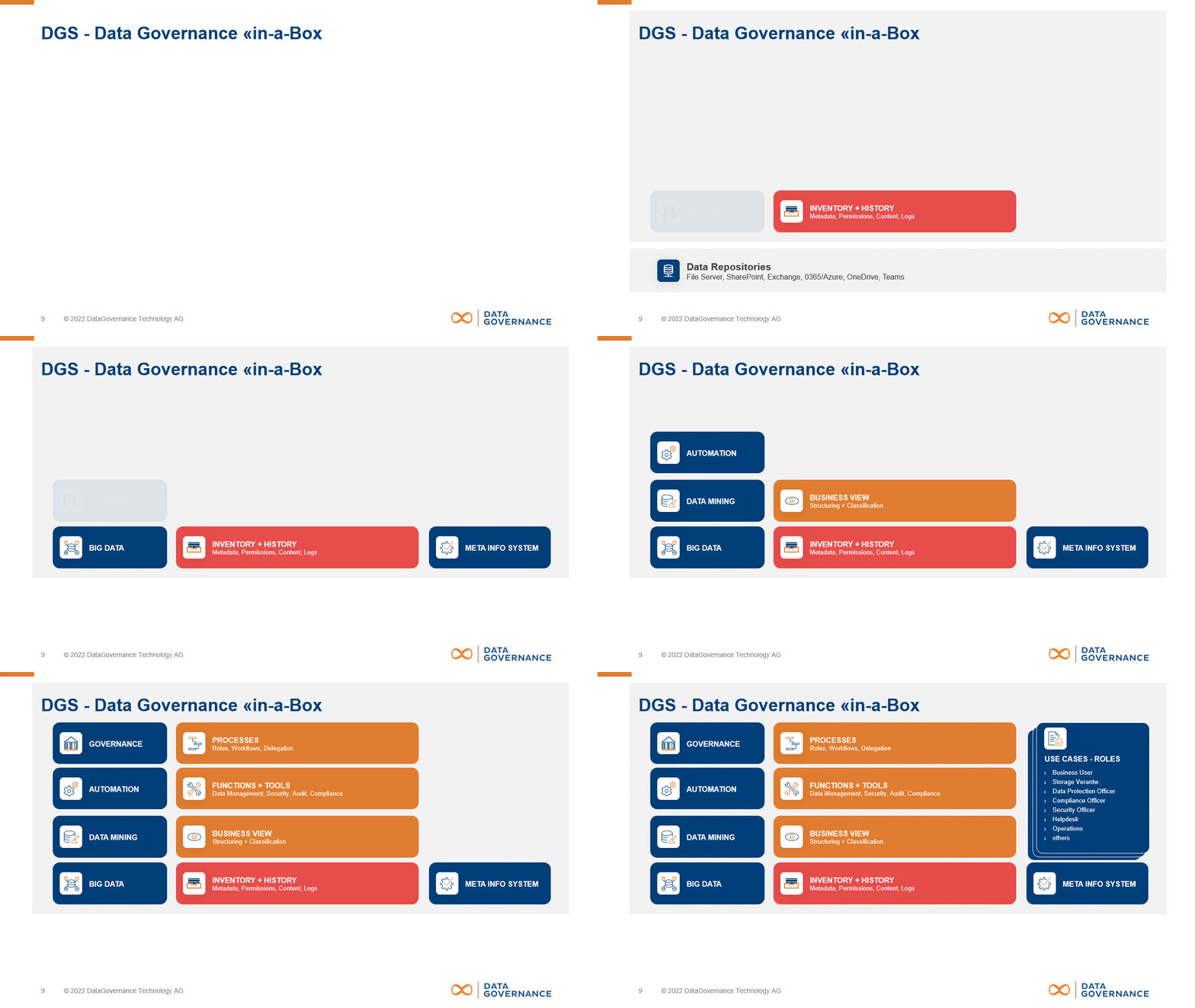
The DataGovernance Suite (DGS) is a powerful platform for data governance, information management and Data Security Posture Management (DSPM), enabling organisations to gain full visibility, control and governance of unstructured data across Microsoft 365 and hybrid IT environments.. It enables organisations to gain complete visibility, control and governance over millions of unstructured data assets across Microsoft 365 and hybrid IT environments. This includes on-premises file servers, Microsoft 365, SharePoint, Microsoft Teams, OneDrive, Exchange and Microsoft Azure.
At the core of the platform is a centralised metadata repository that maintains an up-to-date inventory of all data assets and documents their evolution throughout the entire information lifecycle. Content, metadata, permissions, access activity, classifications and business context are consolidated into a single, comprehensive view of your organisation’s unstructured data.
As a result, organisations gain rapid answers to critical questions: What data exists? Where is sensitive or business-critical information located? Who has access to it? Who is responsible for the data? Which data is subject to regulatory requirements? What risks exist, and where is action required?
The DataGovernance Suite enables organisations to analyse, classify, organise and manage unstructured data throughout its entire information lifecycle, helping to improve security, compliance and operational efficiency. Processes such as data classification, permission analysis, information lifecycle management, data protection, compliance and data clean-up can be automated and assigned to the responsible data owners, business units or IT teams, without requiring direct access to the underlying data.
A role-based access model ensures that IT, information security, data protection, compliance, internal audit, data stewards and business teams each have access only to the information and functionality they need to perform their responsibilities.
With the DataGovernance Suite, organisations reduce complexity, simplify the management of unstructured data and establish a solid foundation for secure Microsoft 365 governance, regulatory compliance and the responsible adoption of artificial intelligence. At the same time, organisations can reduce storage and operational costs, minimise risk and consolidate multiple data management, auditing, security and compliance tools into a single, integrated platform.
FAQ
Find answers to frequently asked questions about the DataGovernance Suite, as well as data governance, Microsoft 365 governance, data classification, enterprise search, compliance, information security and the management of unstructured data. Our FAQs provide practical answers to common challenges in managing unstructured data and help organisations successfully implement their data governance initiatives with greater confidence, efficiency and compliance.
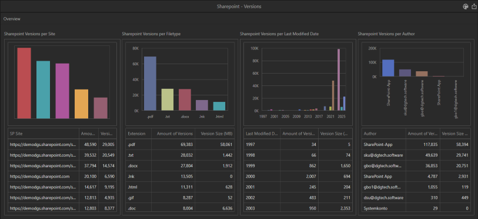
With the DataGovernance Suite (DGS), organisations can analyse SharePoint documents together with their major and minor versions, enabling outdated or unnecessary versions to be identified and selectively removed. Using flexible filtering rules, versions can be selectively deleted based on age, number of retained versions or other criteria, enabling organisations to implement precise version retention policies that align with business, compliance and operational requirements. The clean-up process can be fully automated and scheduled to run at regular intervals, ensuring SharePoint version history remains under control while reducing storage consumption, improving governance and supporting compliance requirements.
The DataGovernance Suite (DGS) provides multiple ways to classify data across traditional file servers and Microsoft 365 environments, including SharePoint and OneDrive. This enables organisations to identify, categorise and govern unstructured data consistently across hybrid IT environments. Classification can be performed either manually by business users or automatically based on predefined policies and rules, enabling organisations to apply consistent data classification across their entire information landscape. This enables even very large volumes of data to be classified consistently and continuously across the organisation, improving data quality, compliance and governance over time. The solution supports both custom classification schemes and seamless integration with Microsoft Information Protection, Microsoft Purview and other security and compliance solutions, enabling organisations to leverage existing security investments while enhancing data governance across hybrid IT environments.
Enterprise search provides a single, central point of access to information that is otherwise distributed across multiple repositories and systems, enabling employees to find relevant content quickly, regardless of where it is stored. The value lies not in moving all data to a new location, but in making existing information easier to find, more complete and accessible in the right business context, regardless of where it is stored.
Enterprise search must never bypass existing access permissions. Enterprise search ensures that employees only see the documents, emails and files they are already authorised to access in the original source systems. Existing access permissions are consistently enforced and never bypassed, ensuring the secure and compliant discovery of information across the organisation. For this reason, it is essential that existing user accounts, roles and access permissions from connected systems are preserved and enforced for every search query, ensuring employees can only discover information they are authorised to access.
The system can centrally index unstructured content from multiple data sources and combine it with structured information such as metadata, business objects, tags, classifications and regular expression (RegEx) patterns. This creates a unified enterprise search experience that delivers more accurate, context-rich results across file servers, Microsoft 365 and other connected systems. Crucially, the content is not stored in Solr solely as full text. During crawling, it is enriched with technical, business and security-relevant attributes, enabling more precise search results, contextual filtering and permission-aware access.